
Quick takeaway: process ownership + team leadership + KPI movement is the winning combination.
Quick exercise
Read your first three bullets and ask one question: would a COO understand what changed because you led operations?
If the answer is unclear, reframe your bullets around measurable flow, quality, and cost outcomes.
What Recruiters Look for in an Operations Manager Resume
Operations hiring teams look for people who improve systems, not just supervise tasks. They need proof that you can stabilize execution, remove bottlenecks, and lead teams through performance pressure. Your resume should show what was broken, what you changed, and what improved.
Strong operations profiles combine metrics and leadership behavior. Metrics show outcomes, while leadership context explains repeatability. For example: “Redesigned handoff process across fulfillment and support teams, improving on-time completion from 82% to 95% within one quarter.”
Recruiters also assess your ability to collaborate across functions. Operations rarely succeeds in isolation. If your resume shows no alignment with finance, product, sales, or quality teams, it may look incomplete.
- Execution quality: throughput, SLA adherence, error-rate reduction.
- Improvement mindset: root-cause analysis, process redesign, SOP standardization.
- People leadership: coaching, escalation handling, workload balancing.
- Cross-functional impact: outcomes delivered with adjacent teams.
Check your Operations Manager resume against job requirements
Include KPI goals, team size, and process ownership scope.
Example Structure of an Operations Manager Resume
Use a structure that is easy to parse and easy to compare: Summary, Skills, Experience, Education/Certifications. Add a short “Selected Outcomes” block only if it helps highlight major KPI movement.
Summary: domain, leadership scope, and operating impact.
Skills: process, people, systems, and analytics grouped clearly.
Experience: each bullet should contain baseline, action, and result.
Education: include role-relevant operations certifications where relevant.
Keep language concrete. Operations resumes become stronger when every claim can be linked to a measurable execution improvement.
Key Skills for an Operations Manager Resume
Target skill language to your environment (service, logistics, manufacturing, or tech operations), but keep universal operations signals visible.
- Process mapping and SOP design
- KPI management and performance reporting
- Root-cause analysis and corrective action planning
- Capacity planning and workflow balancing
- Escalation management and issue resolution
- Team leadership and coaching frameworks
- Lean / continuous improvement techniques
- Cross-functional project coordination
- Quality control and compliance process execution
- Resource allocation and cost optimization
- Operations dashboards and data interpretation
- Stakeholder communication and change adoption
Avoid listing frameworks without proof. If you mention Lean or Six Sigma, show where it changed operational performance.
Common Resume Mistakes for Operations Managers
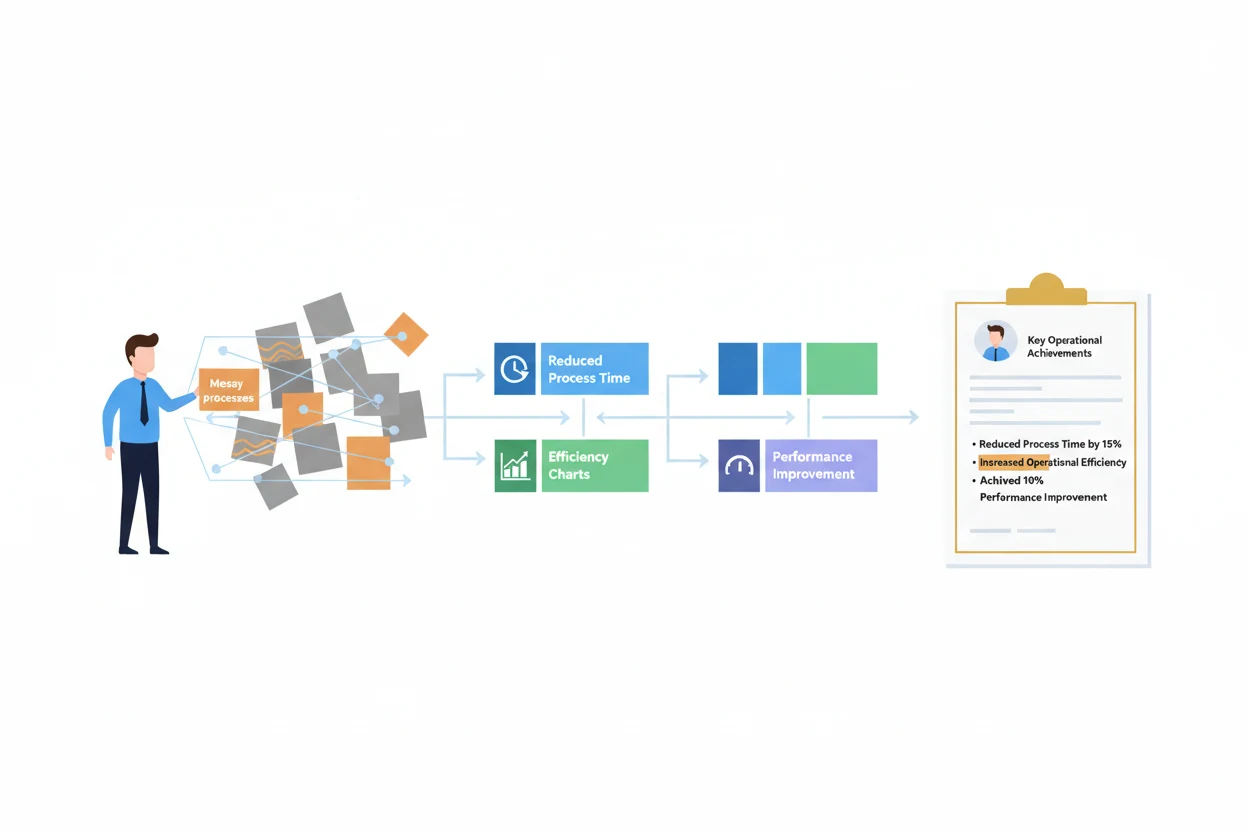
Operations resumes often fail because they describe responsibilities without showing improvement. “Managed team operations” is generic unless you attach KPI movement and context.
Another frequent issue is lack of baseline metrics. Saying performance improved is weaker than showing from where to where and over what period.
- Leadership claims with no measurable operational effect.
- No process detail behind outcome statements.
- Missing ATS keywords from job-specific responsibilities.
- Inconsistent tense and unclear ownership language.
- Too much strategy wording, too little execution evidence.
How to Optimize Your Operations Manager Resume for ATS
Extract keywords directly from the vacancy: KPIs, team scope, operational systems, and process responsibilities. Place them in summary, skills, and role bullets with natural phrasing.
Use standard headers and one-column formatting for parsing stability. Keep metrics in text form, and avoid burying critical evidence in graphics.
Example bullet: “Standardized escalation protocol across support and logistics teams, reducing unresolved critical incidents by 33% and improving SLA compliance.”
Operations Manager Resume Summary Examples
Operations Manager with 7+ years leading high-volume teams and process improvement initiatives. Improved SLA adherence and reduced error rates through workflow redesign and coaching systems.
Data-driven Operations Manager experienced in KPI governance, escalation management, and cross-functional execution. Known for turning operational bottlenecks into measurable throughput gains.
People-focused Operations Manager with strong process discipline and communication skills. Led team performance improvements while maintaining quality and delivery reliability under tight deadlines.
Related Career Resources
Use these resources to refine ATS alignment and improve the clarity of your operational impact narrative.
FAQ
Use throughput, cycle time, SLA performance, defect rate, cost efficiency, on-time delivery, and team productivity outcomes.
Show how your decisions improved team output, process consistency, and cross-functional execution under measurable constraints.
Yes. Keywords like SOP, KPI, Lean, continuous improvement, root-cause analysis, and escalation management are often matched.
One to two pages is common. Keep every bullet focused on measurable outcomes and role-relevant complexity.
Yes. Each environment has different constraints and KPIs, so examples and terminology should match your target context.