
Quick takeaway: ownership + reliability + measurable delivery matters more than buzzwords.
Quick exercise
Read your resume as if you are a hiring manager scanning 80 engineering applications in one evening.
In the first few lines, can they immediately see your role focus and delivery value? If not, even strong architecture work can be missed because the opening signal is weak.
What Recruiters Look for in a Software Engineer Resume
Engineering recruiters need quick confidence that you can ship production code, collaborate with product teams, and maintain system quality under pressure. They scan for role fit in the first seconds: backend, frontend, full-stack, mobile, platform, or infrastructure. If your resume does not make that clear, it can miss the shortlist even with good experience.
Hiring managers especially value outcomes. “Built microservice in Go” is weaker than “built billing microservice in Go that reduced checkout timeout errors by 37%.” The second version proves technical execution and product impact together.
Another high-signal area is ownership scope. Did you only implement tickets, or did you design architecture, lead migrations, improve observability, and mentor teammates? Your bullets should show progression from coding tasks toward system responsibility.
- Stack relevance to the target role and domain.
- Impact metrics tied to latency, uptime, cost, conversion, or release speed.
- Collaboration signals across product, QA, and design.
- Code quality habits: testing, CI/CD, monitoring, incident response.
Check your Software Engineer resume against job requirements
Include required stack, scope, and architecture expectations.
Example Structure of a Software Engineer Resume
Use a structure that mirrors how technical interview pipelines think: role fit first, then proof of execution. A strong order is Summary, Core Skills, Experience, Projects, Education. For junior candidates, Projects can appear above Experience if they show stronger relevance.
Summary: define your engineering lane and strongest outcomes in 2-3 lines.
Skills: cluster by language, framework, cloud, data store, and tooling.
Experience: emphasize architecture decisions and measurable delivery impact.
Projects: show technical ownership with links and short context.
Keep bullet writing consistent: action verb, context, what you built, and what improved. Avoid overloaded paragraphs that hide your best work. If your last two roles are most relevant, allocate more space there and trim older positions.
Key Skills for a Software Engineer Resume
Engineers are hired for stack fit plus problem-solving maturity. List technologies strategically, based on the role you target. A backend posting cares more about API reliability and data modeling, while frontend roles care about performance and UX delivery.
- One primary language (Java, Python, Go, Node.js, C#, or similar)
- API design and versioning (REST/GraphQL)
- Database design and query optimization (PostgreSQL, MySQL, MongoDB)
- Cloud deployment (AWS, GCP, Azure)
- CI/CD pipelines and release automation
- Test strategy (unit, integration, end-to-end)
- Containerization and orchestration (Docker, Kubernetes)
- Observability (logs, metrics, tracing, alerting)
- Performance tuning and scalability planning
- Security basics (auth, secrets, permissions, secure defaults)
- Code review and documentation habits
- Cross-functional delivery with product and design
Common Resume Mistakes for Software Engineers
One of the biggest mistakes is building a “technology museum” resume. Listing every framework you touched in the last decade creates noise and can make your profile look unfocused. Better to show depth in a smaller stack with clear production impact.
Another mistake is writing only implementation details without outcomes. Saying “refactored service layer” does not explain why that work mattered. Did reliability improve? Did release velocity increase? Did cloud costs drop? Hiring teams need that business layer.
- Using buzzwords without describing concrete engineering decisions.
- No mention of testing, code quality, or production reliability.
- Too much emphasis on coursework, too little on delivery results.
- Long paragraphs with no scannable structure.
- Copy-paste summary that does not match the target role.
How to Optimize Your Resume for ATS
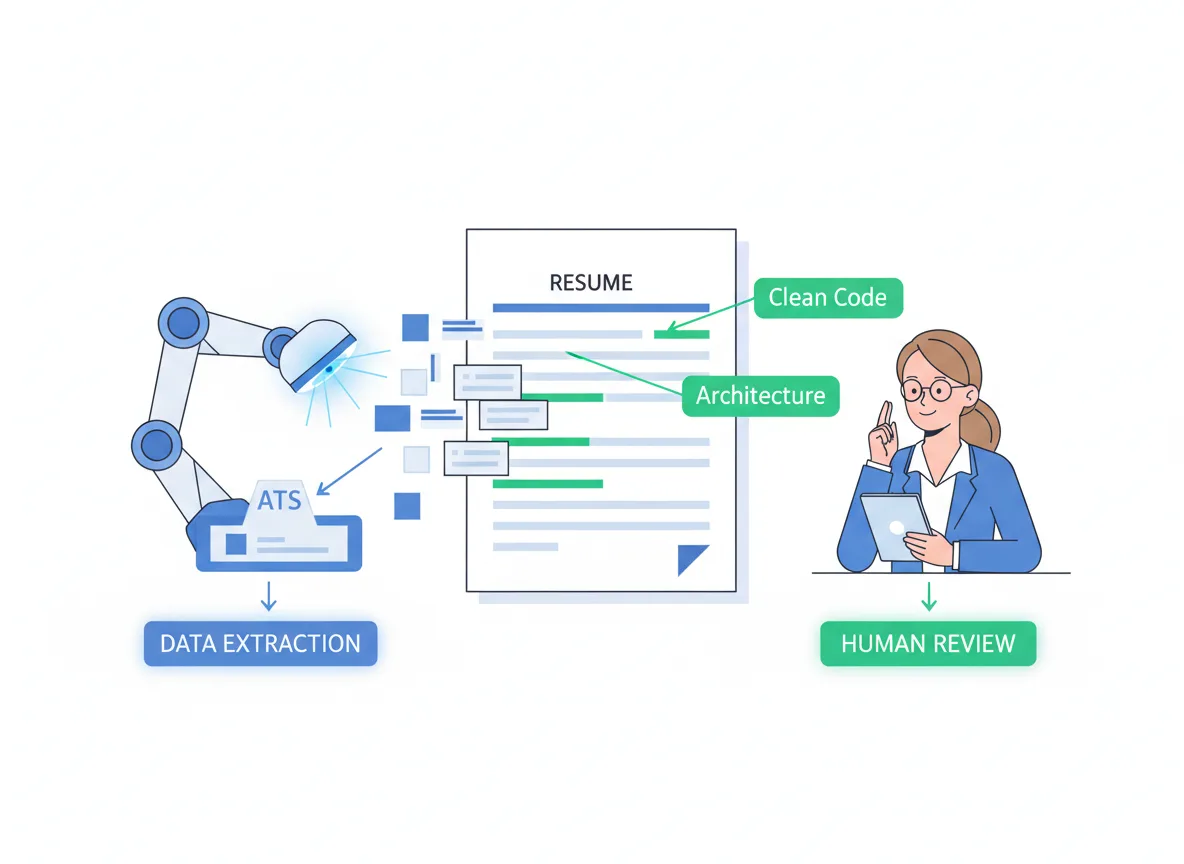
ATS systems often score software resumes by matching exact role language and structure clarity. Pull the top terms from the vacancy and apply them naturally in your resume. If the role says “distributed systems” and your background includes it, write that phrase in your experience bullets where it is true.
Stick to standard section names and avoid unusual formatting. Keep your resume text-based, avoid images for critical content, and use PDF export with readable fonts. For best results, tailor one resume version per role family instead of one generic file for all engineering jobs.
When possible, include keywords near outcomes. Example: “Designed distributed caching strategy that reduced p95 API latency by 28%.” This approach satisfies ATS scanning and demonstrates real engineering thinking.
Software Engineer Resume Summary Examples
Backend Software Engineer with 5+ years of experience building resilient APIs and event-driven services in Go and Python. Improved request latency by 31% and supported 3x traffic growth without service degradation.
Full-Stack Engineer focused on product delivery and performance. Built customer-facing features used by 400k+ monthly users, improved onboarding conversion by 14%, and maintained 99.95% uptime across releases.
Software Engineer with strong DevOps collaboration and CI/CD expertise. Reduced deployment time from 45 to 12 minutes and implemented observability standards that lowered production incident resolution time.
Related Career Resources
Use these pages to improve relevance before sending your next application.
FAQ
Yes, if your repositories are clean and relevant. Add links to projects that show production-level code quality, architecture thinking, tests, and documentation.
They prioritize stack fit, impact in previous roles, and evidence of ownership. Concrete delivery outcomes usually matter more than long tool lists.
List only tools you can defend in technical interviews. A focused stack with real depth is stronger than a long keyword dump.
Senior profiles often need two pages, but keep content concise. Remove outdated technologies and focus on recent systems-level impact.
Most ATS tools parse plain text best. Avoid embedding critical information in formatted code blocks or images.