
Quick takeaway: strategy is important, but measurable delivery is what gets interviews.
Try this
Look at your product manager resume as a recruiter would: fast, skeptical, and metric-focused.
If the first 2-3 lines do not explain product scope, decision ownership, and impact, the rest of your roadmap story may never be read.
What Recruiters Look for in a Product Manager Resume
When hiring teams read PM resumes, they look for a clear product narrative: what problem space you owned, who your users were, how you prioritized opportunities, and what measurable results came from your decisions. Generic statements like “drove roadmap” are too soft. They need evidence.
Strong PM resumes connect discovery work to release outcomes. For example: “Led customer interviews that reframed onboarding priorities, shipped revised activation flow, and increased day-7 activation by 11%.” That single line shows research, prioritization, execution, and business impact.
Recruiters also want to understand your operating environment. Mention if you worked in startup, scale-up, enterprise, or regulated products. Hiring teams use this context to judge complexity fit and collaboration readiness.
- Product ownership scope (feature area, platform, or full domain).
- Impact metrics (activation, retention, conversion, churn, ARR, NPS).
- Execution maturity (roadmap, specs, rituals, launch management).
- Cross-functional influence with engineering, design, and GTM teams.
Check your Product Manager resume against job requirements
Include product scope, KPIs, and collaboration expectations.
Example Structure of a Product Manager Resume
PM resumes are strongest when they balance strategic context and execution details. Start with a summary that states product domain and operating style. Then show skills that map to discovery, delivery, analytics, and communication. Experience should prove your decision-making quality through outcomes.
Summary: domain, stage, and product outcomes in plain language.
Skills: prioritization, experimentation, analytics, roadmap ops, stakeholder management.
Experience: problem, approach, release, and measurable business/user impact.
Education/Certifications: include only those relevant to product execution.
Do not hide your best achievements deep in older roles. Place your strongest impact bullets in the most recent experience section where recruiters naturally spend the most attention.
Key Skills for a Product Manager Resume
Choose skills that reflect your day-to-day product work, not abstract leadership claims. Every skill should be backed by at least one experience bullet.
- Product discovery and user research
- Prioritization frameworks (RICE, impact/effort, opportunity scoring)
- Roadmap planning and release sequencing
- A/B testing and experiment design
- Funnel analysis and KPI instrumentation
- PRD writing and acceptance criteria definition
- Agile delivery rituals and backlog management
- Stakeholder alignment and decision communication
- SQL basics and analytics interpretation
- Feature launch and adoption tracking
- Retention and lifecycle optimization
- Cross-functional leadership without formal authority
Common Resume Mistakes for Product Managers
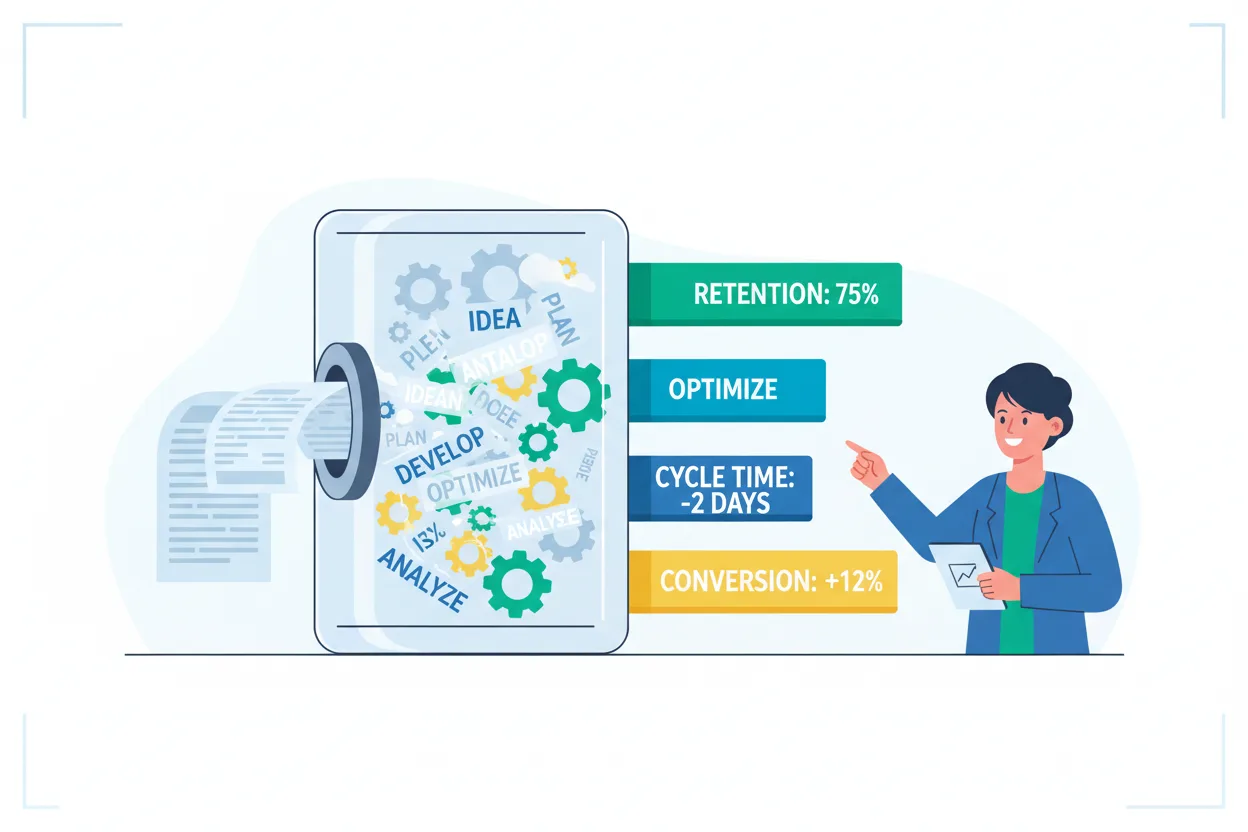
The most common PM resume problem is overusing strategic language with no delivery proof. Terms like “vision,” “ownership,” and “leadership” sound strong, but without outcomes they become filler. Recruiters want to see what shipped and what improved.
Another issue is role confusion. Some resumes mix product marketing, project coordination, and product management bullets without clarifying the actual accountability. Be explicit about decision rights and product scope to avoid ambiguity.
- Roadmap bullets without user problem context.
- No mention of post-launch measurement.
- Too many soft skills, too few operating skills.
- Generic summary used for every PM application.
- Missing domain context (B2B, B2C, SaaS, fintech, healthtech).
How to Optimize Your Resume for ATS
PM roles vary widely across companies, so ATS keyword matching can be strict. Pull language directly from the role description: product discovery, roadmap, experimentation, SQL, stakeholder management, launch strategy, and specific domain terms. Use those keywords only where true in your background.
Keep your formatting clean and parse-friendly. Use standard headers, avoid text-heavy graphics, and keep sections short. If the role is growth-focused, emphasize activation and retention outcomes. If it is platform-focused, highlight reliability, scalability, and internal stakeholder outcomes.
The strongest ATS approach is tailored relevance. Build one base resume, then adjust the summary and top 4-6 bullets for each role before applying.
Product Manager Resume Summary Examples
Product Manager with 6+ years of SaaS experience leading onboarding, billing, and retention initiatives. Improved activation by 15% and reduced voluntary churn by 9% through discovery-led roadmap prioritization.
B2B Product Manager focused on workflow automation and enterprise adoption. Partnered with design and engineering to launch integrations that increased weekly active usage by 22% within one quarter.
Growth-oriented Product Manager with strong experimentation and analytics skills. Led lifecycle improvements that increased trial-to-paid conversion while reducing acquisition payback period.
Related Career Resources
Explore adjacent guides to tailor each PM application with sharper positioning.
FAQ
A focused summary with product domain, stage exposure, and measurable outcomes such as activation, retention, revenue, or release velocity improvements.
Yes. Most PM roles expect comfort with analytics tools, experimentation concepts, and collaboration with engineering. Keep this section practical and role-specific.
Use adjacent metrics like feature adoption, conversion uplift, churn reduction, cycle time, support ticket volume, or NPS movement.
Include it where true, but balance it with execution details such as discovery, prioritization, launch coordination, and post-release analysis.
Usually no. Tailor examples, language, and metrics to the target environment because buying cycles, KPIs, and user behaviors differ significantly.